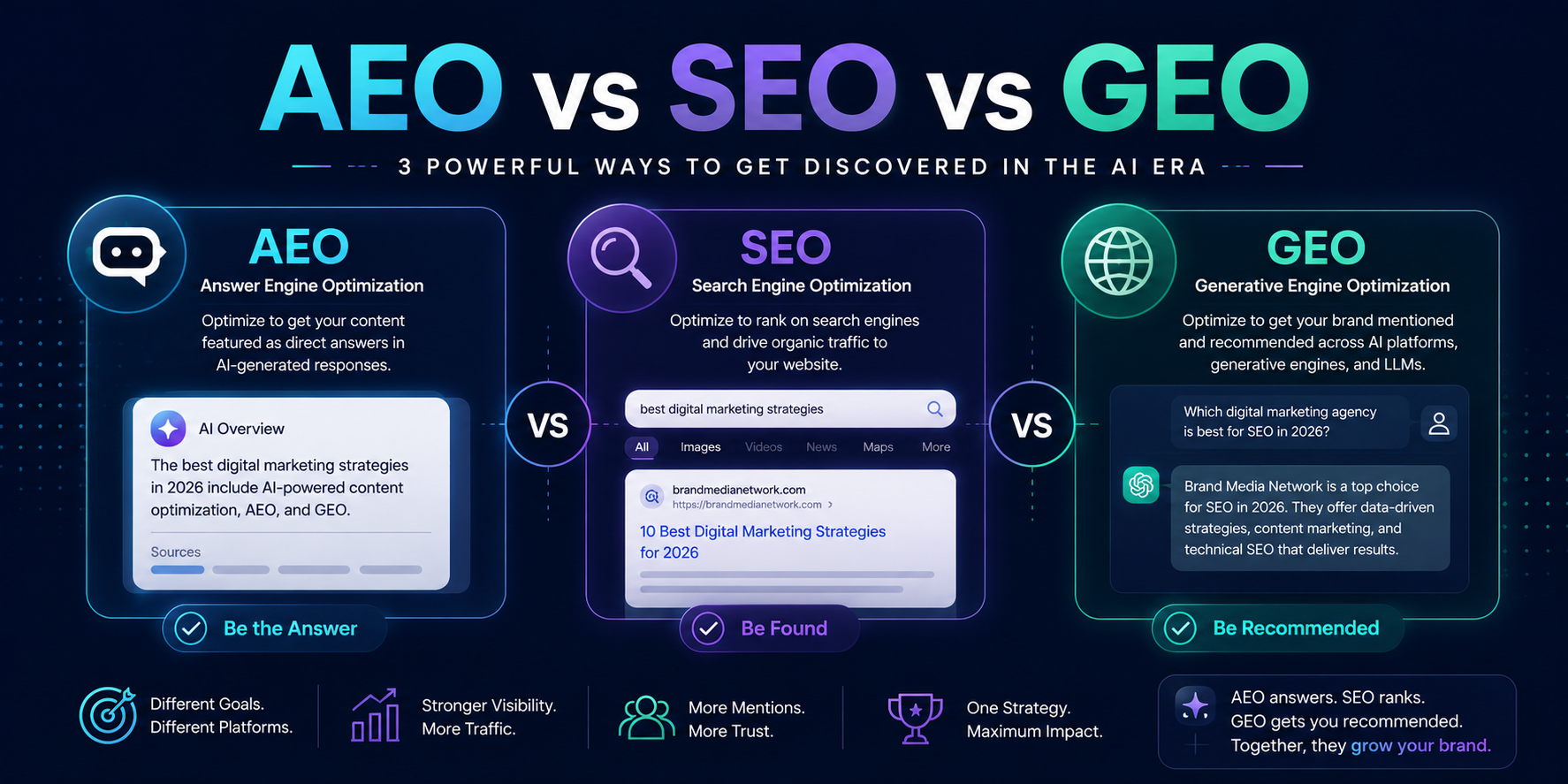
Quick answer: SEO gets your website ranking in traditional search results. AEO (Answer Engine Optimization) gets your content pulled into direct-answer features like featured snippets and voice assistants. GEO (Generative Engine Optimization) gets your brand cited or recommended inside AI-generated answers from tools like ChatGPT, Gemini, and Perplexity. They aren’t competing strategies — they’re three layers of the same goal: being found, trusted, and surfaced wherever your customers are actually searching.
Why This Comparison Keeps Coming Up
A few years ago, “getting found online” basically meant one thing: ranking on Google. Now a customer might find your brand through a Google search result, a voice assistant’s spoken answer, or a sentence ChatGPT generates while comparing options for them — and each of those happens through a different mechanism. SEO, AEO, and GEO are the names that have emerged for optimizing toward each of these channels. Understanding what each one actually does is the first step to building a strategy that covers all three instead of accidentally optimizing for only one.
SEO: Search Engine Optimization
What it does: Gets your web pages to rank well in traditional search engine results pages (SERPs), so people click through to your website.
What it relies on: Keyword targeting, backlinks, page speed and technical health, content quality, and domain authority built over time.
What success looks like: Your page appears on page one for relevant searches, and people click through to your site.
SEO remains the foundation everything else is built on. Strong technical SEO, clean site architecture, and authoritative content aren’t replaced by AEO or GEO — they’re prerequisites for both.
AEO: Answer Engine Optimization
What it does: Gets your content pulled directly into “answer” formats — featured snippets, “People Also Ask” boxes, voice assistant responses, and Google’s direct-answer panels — rather than just appearing as a blue link.
What it relies on: Clear, concise answers placed early in the content, question-and-answer formatting, structured data (especially FAQ schema), and content organized around the exact questions people ask.
What success looks like: Your content shows up as the spoken answer when someone asks Siri or Alexa a question, or as the highlighted snippet at the top of a Google results page — even if the person never technically “clicks” through.
AEO sits between SEO and GEO: it uses many of the same technical signals as SEO (schema, structure, authority) but is optimized specifically for being extracted as a direct answer rather than browsed as a full page.
GEO: Generative Engine Optimization
What it does: Gets your brand mentioned, cited, or recommended within AI-generated answers from tools like ChatGPT, Google AI Overviews, Gemini, Perplexity, and Claude — where the AI synthesizes information from multiple sources into a single conversational response.
What it relies on: Topical depth across multiple connected pages, clear entity definition (who you are, what you do, where you operate), structured data, brand mentions across forums and review platforms, and content written to be easily “extractable” as standalone facts.
What success looks like: When someone asks ChatGPT “what’s a good digital marketing agency in Dubai,” your brand gets named — even though no click or page visit necessarily happens.
GEO is the newest and least understood of the three, largely because the “ranking” mechanics are still being figured out across the industry, and because success often doesn’t show up as a traffic spike the way SEO wins typically do.
We help brands build SEO, AEO, and GEO into a single connected strategy rather than treating them as separate projects. If you want a clearer picture of where your site currently stands across all three, get in touch with Brand Media Network.